Updated: Sep 1
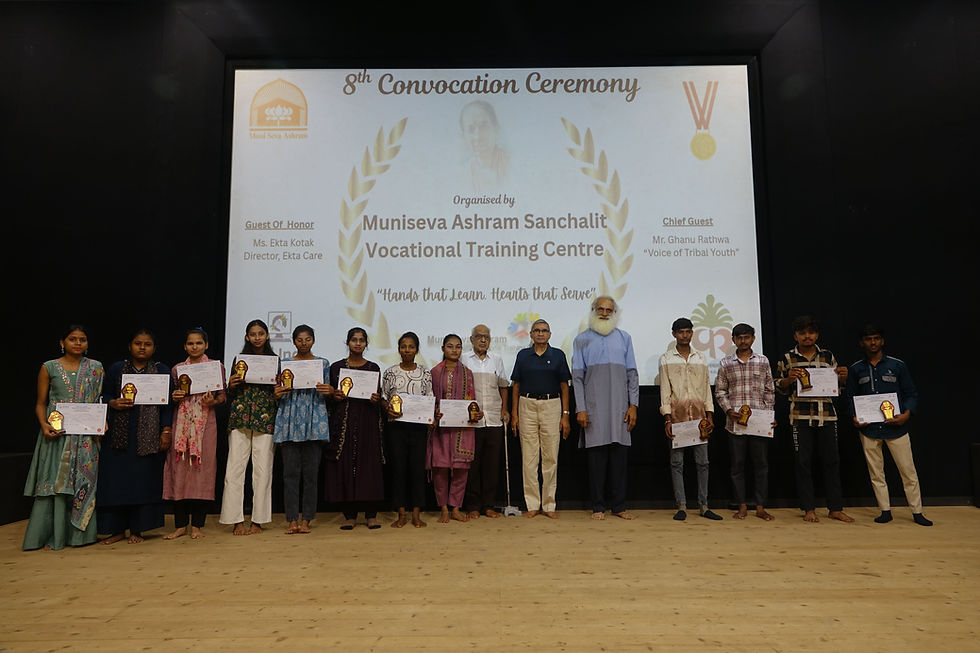
Since 2010, the Vocational Training Centre (VTC) at Muni Seva Ashram (MSA) has been quietly changing the trajectory of young lives in the tribal belts of Gujarat. Running courses like the Multi-Purpose Health Worker (MPHW) program and BPO training, the centre does more than teach technical skills — it builds confidence, communication, and character.
None of this would be possible without the generosity of donors who believe in this mission. Annually to contribute a full year's salary for teachers, for students habilation at the centre. That single contribution keeps the doors open for tribal students who would otherwise have no access to this kind of training.
The real story, though, is in what happens to the students once they walk through those doors. Here are two of them.
Asmita and Sumitra: Sisters Who Rewrote Their Own Story

Asmita and Sumitra grew up in a small village in Chhota Udepur — one of Gujarat's most tribal districts. Their family of five shared a single-room hut, farming a small government-allotted plot of land to get by.
Asmita's childhood was marked by something far harder than poverty: she suffered from fits and seizures, and the village witch-doctor declared it an incurable, lifelong condition. It was a verdict that could have closed every door for her.
Instead, in 2016, Asmita walked through the doors of VTC. While training as a medical assistant, she finally received proper medical treatment — including hospitalization at MSA's own Kailash Cancer Hospital & Research Centre (KCHRC). The "incurable" condition was treated. Today, Asmita works at that very same hospital as a Physician's Assistant.
Her sister Sumitra followed months later, enrolling at VTC and going on to work at a respected doctor's clinic in Padra, near Vadodara, before being transferred to KCHRC herself.
Two sisters. One decision to try something new. Two completely rewritten futures.
Geeta Rathva: An Orphan Who Became a Role Model

Geeta Rathva is 23 years old and comes from Moti Umbharvan, a remote village in Panchmahal District. She lost both her parents when she was very young, and her grandmother stepped in to raise her.
Life for an orphaned girl from a farming family with almost no resources is rarely easy — Geeta struggled even for basic necessities. Still, she pushed through and completed her higher secondary education at her village's government school.
It was someone from her own village who first told her about the Vocational Training courses at Muni Seva Ashram, Goraj. Geeta enrolled in the Multi-Purpose Health Worker course, and after successfully completing it, she was hired at the Chemotherapy Department of Kailash Cancer Hospital & Research Centre as an Assistant OPD Nurse.
Through sheer tenacity, Geeta has gone from having almost nothing to becoming a role model for tribal girls across her region.
Why These Stories Matter
Asmita, Sumitra, and Geeta didn't just gain jobs — they gained independence, dignity, and the ability to shape their own futures. Their stories are living proof of what focused skill development and unwavering support can do, especially for young women in India's most underserved tribal communities.
And it all traces back to something simple: a donor's belief that funding one English teacher's salary could open doors that seemed permanently shut.
This is women empowerment in action — not as a slogan, but as three young women walking into hospitals every day, doing meaningful work, and lighting the way for the girls who will come after them.